Case Study: Why This Reduction Called for a Full Anchor Pattern
Scars are the first thing most women ask about. They want smaller, lighter breasts, but they want to know exactly what that will cost them on the surface of the skin. It is a fair question, and the honest answer changes from patient to patient.
This patient was 48 years old, 5 feet 2 inches tall, and 145 pounds. Her breasts were heavy and had dropped low on her chest, with loose skin that had lost its ability to snap back. We used a full anchor incision pattern for her surgery. That choice was not automatic, and it is worth explaining why it was the right one here.
What Her Breasts Looked Like Before
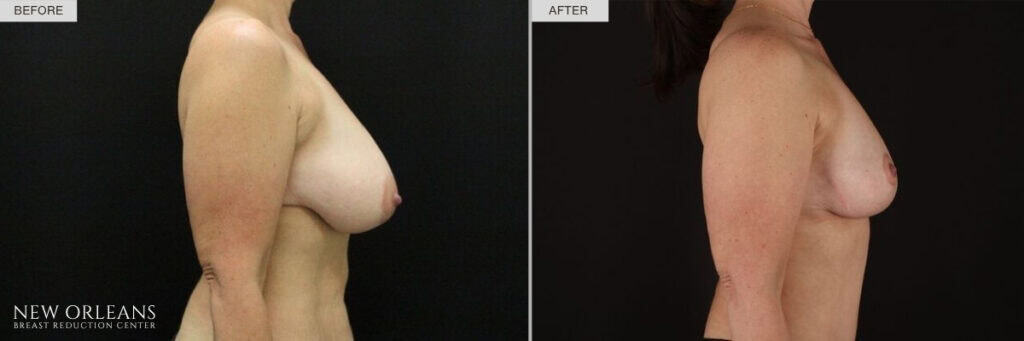
The before photos show breasts that had lost their internal support. The volume had slid downward, so the lower half of each breast carried the weight while the upper slope looked flat and empty. From the side, the breast hung forward and well past the crease underneath.
Her nipples sat low and angled outward. The skin envelope had stretched in every direction, not just top to bottom. That detail drove the entire surgical plan.
What the Anchor Pattern Actually Is
The anchor pattern uses three connected incisions. One circles the areola. One runs straight down from the areola to the crease under the breast. The third runs sideways along that crease.
Traced together, those lines look like an upside-down anchor, which is where the name comes from. The alternative is a vertical pattern, sometimes called a lollipop, which uses only the first two lines and skips the horizontal one. Less incision sounds better on its face. The question is always whether the shorter pattern can deliver the result.
Why the Third Incision Earns Its Place
Loose skin has to be removed in two directions, not one. A vertical incision lets us take skin out from side to side, so the breast gets narrower. It does very little to shorten a breast from top to bottom.
For this patient, both problems were present. Her breast was too wide and too long. The horizontal incision along the crease is what let us remove the excess vertical height and set the bottom of the breast at a proper level. Without it, we would have narrowed her breast while leaving it hanging just as low.
We also consider how the skin will behave after surgery. Skin that has been stretched for many years loses its spring. It does not contract on its own the way younger skin does. When we ask tired skin to do work it cannot do, the breast settles back down, and the shape fails within a year or two. We would rather place one more scar than hand a patient a result that does not hold.
Shape Comes From the Tissue Underneath
There is a common belief that a reduction result is held up by tight skin. That is not how we build it. We reshape the breast tissue itself and secure it into a narrower, higher form before the skin is ever closed over the top.
That internal work carries the lift for the long term. The skin then wraps around the shape we have already created. For this patient, the anchor pattern gave us the access and the control to do that reshaping properly.
Where the Three Scars Sit
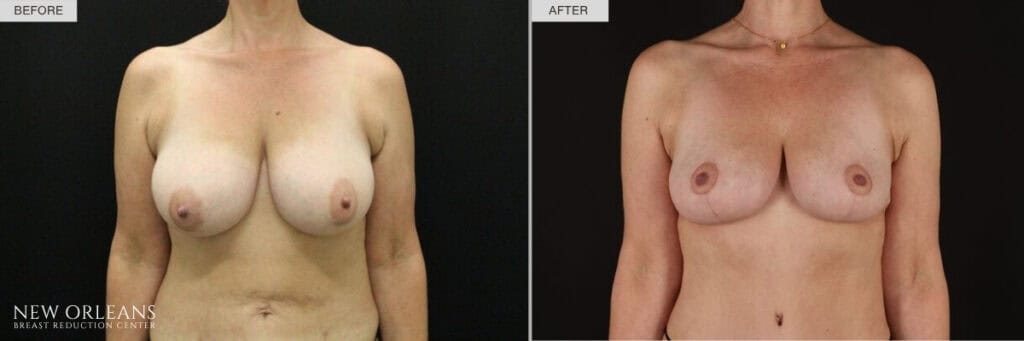
Scar placement matters as much as scar length. The incision along the crease is tucked into the fold under the breast, where it stays hidden by the breast itself in most positions and disappears under any bra or swimsuit.
The circular incision follows the natural border of the areola, where the change in skin color helps camouflage it. The vertical line down the front is the most visible of the three. It also sits on a part of the breast covered by nearly every garment a woman wears.
The Result at Three Months
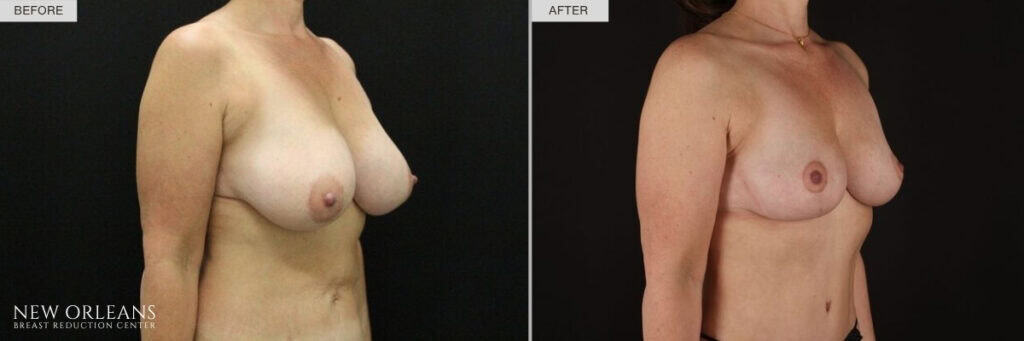
At three months, her breasts sit higher and hold a rounder, more compact shape. The bottom-heavy droop is gone, and fullness has returned to the upper portion. From the side, the breast projects forward rather than falling toward her waist.
The anchor scars are still pink at this point, which is expected this soon after surgery. They will continue to flatten and lighten over the coming year. The shape and position, though, are already established.
Trying to Weigh the Scars Against the Result?
Every breast reduction leaves scars. The real question is which pattern your breasts actually need, and that comes down to how much tissue is coming out, how much skin is left over, and whether that skin can still tighten on its own. The anchor is not a worst-case outcome. For many women, it is the only way to get a shape that lasts.
Contact the New Orleans Breast Reduction Center to schedule a consultation. We will examine your skin, take your measurements, and tell you honestly which approach would give you the best long-term result.